CHILD SAFETY
Safe and Inclusive Schools
The care, safety and wellbeing of children and young people is a central and fundamental responsibility of Catholic education. This commitment is drawn from, and inherent to, the teaching and mission of Jesus Christ, with love, justice and the sanctity of each human person at the heart of the Gospel.
The School brings to life the mission of the Catholic Church by engaging and aligning all efforts toward the achievement of our vision for education: faith-inspired educational excellence for a hope-filled future. Through this mission, we are committed to fostering environments where every child and young person is known, valued and protected, and where their dignity is upheld in all that we do.
CHILD SAFETY
Safety First
DOSCEL promotes inclusive and safe schools by:
- upholding the primacy of the safety and wellbeing of children and young people
- empowering families, children, young people and staff to have a voice and raise concerns
- implementing rigorous risk-management and employment practices.
CHILD SAFETY
Risk Mitigation
Child safety is a shared responsibility. Every person involved in the DOSCEL Office and our schools plays an important role in promoting the safety and wellbeing of all children, promptly raising any concerns and understanding and mitigating risk factors.
We are committed to regularly reviewing our child‑safe practices, identifying and managing risks to children, and actively seeking input from students, families, staff, and volunteers to strengthen our ongoing strategies.
As part of this commitment, DOSCEL will be guided by Victorian Catholic Education Authority (VCEA), which provides structured monitoring to ensure Catholic schools meet all regulatory requirements and maintain a cycle of continuous improvement. The guiding principles underpinning VCEA’s compliance assurance activities support schools in embedding a robust and sustainable child‑safe culture aligned with best practice.
CHILD SAFETY
Victorian Child Safe Standards
In July 2021, the Victorian Government announced that new Child Safe Standards would be implemented to further strengthen child safe environments and protect children from abuse.
On 1 July 2022, 11 new Child Safe Standards came into effect, replacing Victoria’s seven standards and principles (including Ministerial Order No. 870 – Child Safe Standards – Managing the risk of child abuse in schools).
Key changes to the new Child Safe Standards include new requirements to keep children and young people safe, including:
- involving families and communities in efforts to keep children and young people safe
- a greater focus on safety for Aboriginal and Torres Strait Islander children and young people
- managing the risk of child abuse in online environments
- greater clarity on the governance, systems and processes to keep children and young people safe.
CHILD SAFETY
Victorian Child Safe Standards
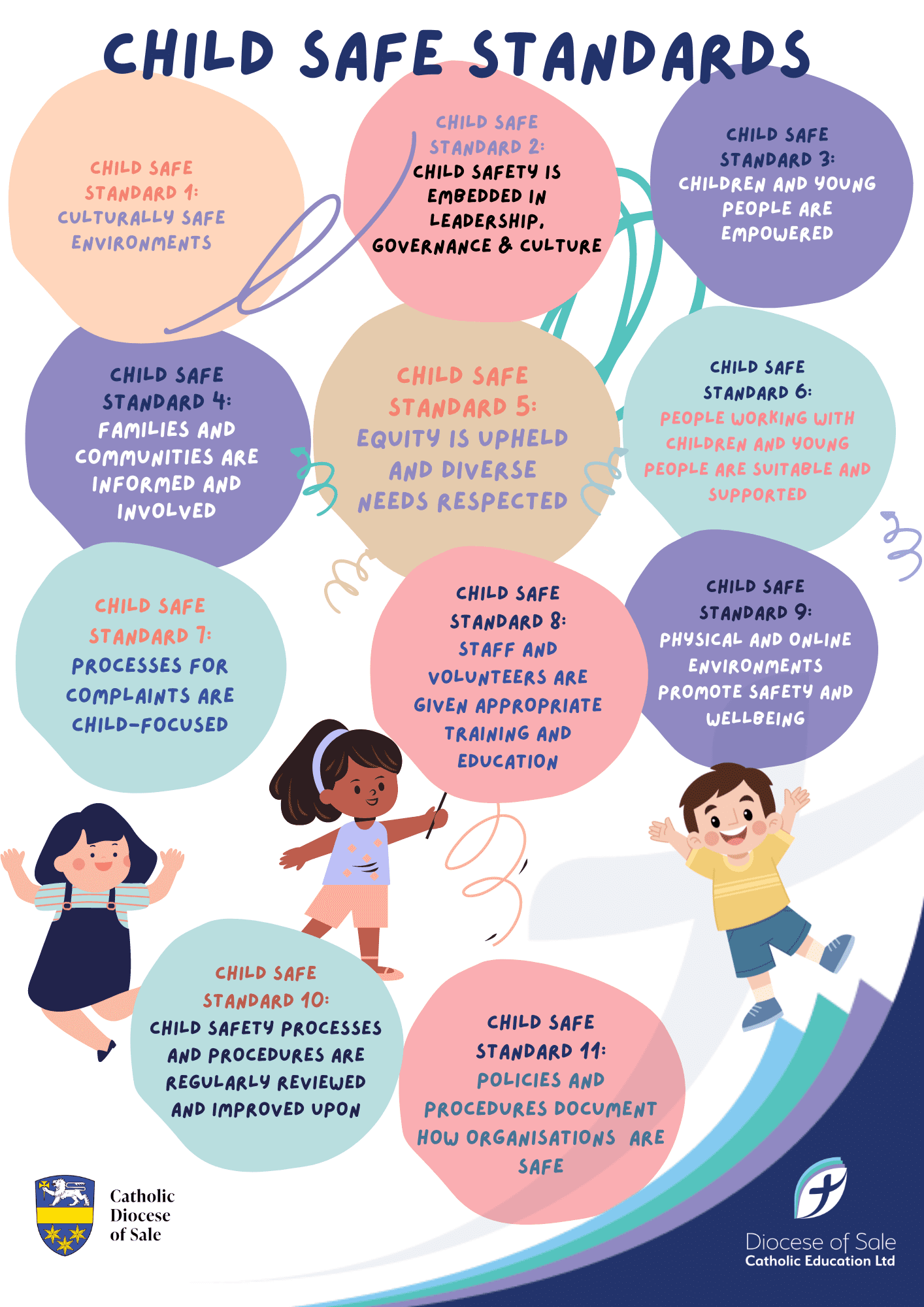
Child Safe Standard 1 – Organisations establish a culturally safe environment in which the diverse and unique identities and experiences of Aboriginal children and young people are respected and valued.
Child Safe Standard 2 – Child safety and wellbeing is embedded in organisational leadership, governance and culture.
Child Safe Standard 3 – Children and young people are empowered about their rights, participate in decisions affecting them and are taken seriously.
Child Safe Standard 4 – Families and communities are informed, and involved in promoting child safety and wellbeing.
Child Safe Standard 5 – Equity is upheld and diverse needs respected in policy and practice.
Child Safe Standard 6 – People working with children and young people are suitable and supported to reflect child safety and wellbeing values in practice.
Child Safe Standard 7 – Processes for complaints and concerns are child focused.
Child Safe Standard 8 – Staff and volunteers are equipped with the knowledge, skills and awareness to keep children and young people safe through ongoing education and training.
Child Safe Standard 9 – Physical and online environments promote safety and wellbeing while minimising the opportunity for children and young people to be harmed.
Child Safe Standard 10 – Implementation of the Child Safe Standards is regularly reviewed and improved.
Child Safe Standard 11 – Policies and procedures document how the organisation is safe for children and young people.
CHILD SAFETY
More Information
Protect Documents
CHILD SAFETY
Reporting and Contacts
There are a number of supports available when responding to incidents, disclosures
or suspicions of child abuse.
Diocese of Sale Catholic Education Limited
Email: [email protected]
Legislation
- Child Wellbeing and Safety Act 2005 (Vic.)
- Education and Training Reform Act 2006 (Vic.)
- Education and Training Reform Regulations 2017 (Vic.)
- Ministerial Order No. 1359 – Implementing the Child Safe Standards – Managing the Risk of Child Abuse in Schools and School Boarding Premises

Creating Safe School Communities
Working together to safeguard children, young people and vulnerable adults